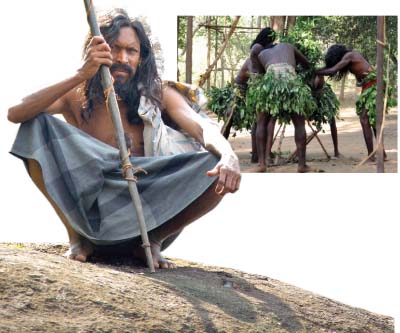
Veddas are the aborigines or indigenous people of Sri Lanka . Mahawansa reveals that Veddas are descended from Prince Vijaya (6th-5th century BC), the founding father of the Sinhala nation, through Kuweni a woman of the indigenous Yakka clan whom he had espoused.
Bori Bori Sellam-Sellam Bedo Wanniya,
Palletalawa Navinna-Pita Gosin Vetenne,
Malpivili genagene-Hele Kado Navinne,
Diyapivili Genagene-Thige Bo Haliskote Peni,
Ka tho ipal denne
Palletalawa Navinna-Pita Gosin Vetenne,
Malpivili genagene-Hele Kado Navinne,
Diyapivili Genagene-Thige Bo Haliskote Peni,
Ka tho ipal denne
(A Vedda honeycomb cutter's folk song, meaning 'The bees from yonder hills of Palle Talawa and Kade suck nectar from the flowers and made the honeycomb. So why should you give them undue pain when there is no honey by cutting the honeycomb. (Wikepedia)
The Mahavansa relates that following the repudiation of Kuveni by Vijaya, in favour of a 'Kshatriya' princess from the Pandya country, their two children, a boy and a girl, departed to the region of Sumanakuta (Adam's Peak in the Ratnapura District, and their progeny gave rise to the Veddas. Veddas are believed to be identical with the 'Yakkhas' of yore. Veddas are also mentioned in Robert Knox's history of his captivity by the King of Kandy in the 17th century. Knox described them as 'wild men', but also said there was a 'tamer sort,' and that the latter sometimes served in the king's army.
Archaeological scholars such as Nandadeva Wijesekera (Veddas in transition 1964) hold the view that the Ratnapura District, which is part of the Sabargamuwa Province, is known to have been inhabited by the Veddas in the distant past. The very name 'Sabaragamuwa' is believed to have meant the village of the Sabaras or 'forest barbarians'. Such place-names as Vedda-gala ('Vedda Rock'), Vedda-ela ('Vedda Canal') and Vedi-kanda ('Vedda Mountain') in the Ratnapura District also bear testimony to this.
As observed by Wijesekera, a strong Vedda concentration is discernible in the population of Vedda-gala and its environs. As for the traditional original language of the Veddas, it is presently used primarily by the interior Veddas of Dambana. Communities, such as Coastal Veddas and Anuradhapura Veddas that do not identify themselves strictly as Veddas, also use Vedda language in part for communication during hunting and or for religious chants.
Indigenous cultures are helping to save the world's environment
Long, long ago, according to the word of the Buddha in the Agganna Sutta, the earth's inhabitants all lived in bliss, knowing no discrimination between such opposites as male and female, rich and poor, good and bad, ruler and subject. The very earth itself was delightfully edible and sweet as honey. Day and night, our remote ancestors abided in a state of illumination without effort and without a sense of individuality or private selfhood.
Gradually, however, this Golden Age gave way to a long period of decline. The earth began to yield its bounty only with the increasing toil of its inhabitants. Greed, hunger, sex, theft, cruelty, violence and murder manifested in the world until finally a state of anarchy prevailed. In order to restore order and balance, our ancestors thought together and selected by common consensus one of themselves to be king, for which function the others agreed to give him a portion of their food.
Tradition recalls that this original king was called Mahasammata, which in plain English means 'thinking together in common consensus'. Today
 |
perhaps more than ever before, this profound vision of human culture's lofty origins, near-dissolution into chaos, and happy recovery thanks to the wisdom of wide public consensus (calledMahasammata) may be taken as a vivid reminder that all communities can learn to live peacefully with each other to create a richer and happier environment for all. Even now there is a growing consensus that cultural diversity is as essential as bio-diversity for the survival of humanity upon earth. Sri Lanka is only one example, but the issue is a global one.
Until only recently, however, the world's governments and development agencies looked upon traditional cultures as 'obstacles to progress' that could be overcome or eliminated altogether through modern education and economic growth. Indigenous and tribal communities especially were regarded with scorn and suspicion by agencies whose policies solely reflected a modern urban point of view that is far removed from that of the subsistence economies of 'backward' communities. Governments around the world, including here in Sri Lanka, sought to 'rehabilitate' whole tribal communities according to urban tastes through grand and costly schemes designed to assimilate these ancient communities, with or without their consent, into the turbulent mainstream of modern society.
All this is fast changing today with the emerging awareness of the critical role that indigenous and other traditional communities play in maintaining the balance between society and nature through environmentally sustainable practices based upon indigenous knowledge and age-old traditions of ancestral wisdom. And this is no mere abstraction, for upon it depends the survival or collapse of the world's richest and most powerful industrial societies thanks to stubborn patterns of thinking that result in disastrously wasteful patterns of resource consumption.
The role of indigenous people in development and the environment has not escaped the notice of agencies like the United Nations or the World Bank, and this role is only likely to grow in years to come. At the 1992 'Earth Summit' in Rio de Janeiro, for instance, the formulation of Agenda 21, a world environmental agenda for the next century included far-reaching resolutions designed to recognize and strengthen the role of indigenous people and their communities. Every major development agency has reformulated its policies to reflect the growing role of indigenous people and environmentally sustainable development. The informed participation of indigenous people is now mandated in projects funded by the World Bank, and borrower-nations are obliged to be responsive to the needs and aspirations of their own indigenous people.


